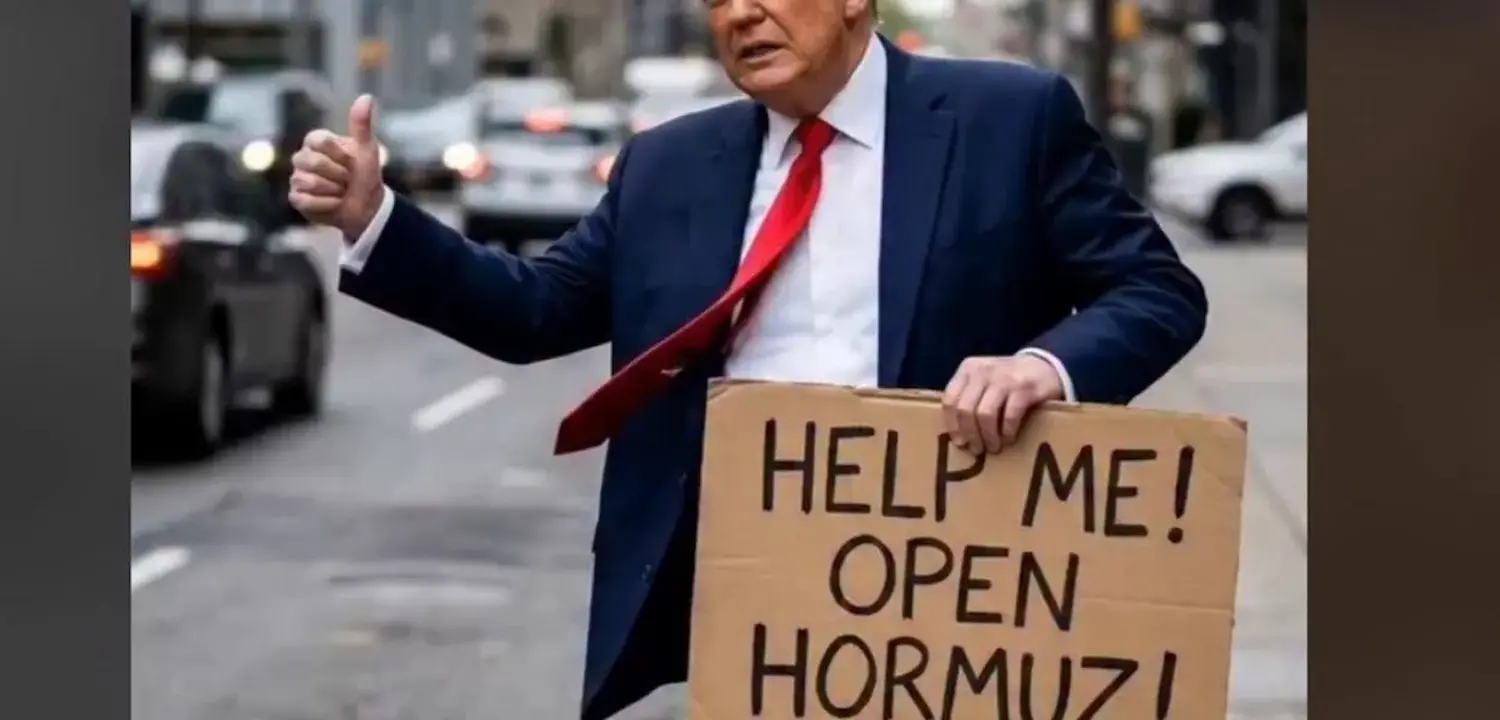

U.S. President Donald Trump has become a target of international mockery after calling for foreign support to secure the Strait of Hormuz amid escalating tensions with Iran.
The “America First” doctrine has hit a geographic and diplomatic wall in the Persian Gulf. By asking allies to share the burden of patrolling a passage that carries 20% of the world’s oil, Trump signals that U.S. naval hegemony can no longer operate as a blank check, unverified by the international community.
Trump Asking For Help At #HormuzStrait Crisis! pic.twitter.com/zablqi5tbC
— Iran Military Media ☫ (@IRMilitaryMedia) March 16, 2026
The Hormuz bottleneck and global reliance
The Strait of Hormuz is the most sensitive chokepoint on the planet, linking Middle Eastern producers to global markets. Any instability in this 21-mile-wide waterway triggers immediate spikes in crude prices, directly impacting inflation at American and European gas pumps.
According to Amena Bakr, senior energy analyst at Energy Intelligence, Trump’s attempt to outsource route security reflects a saturation of the Pentagon’s power projection across multiple conflict theaters. Hesitation from traditional allies like the UK and France suggests the political cost of an escalation with Iran is currently seen as prohibitive.
The war of narratives on digital platforms
Negative backlash on social media, fueled by viral videos often traced to Iranian sources, focuses on the image of a government “begging” for assistance. This phenomenon demonstrates how digital diplomacy can subvert traditional military power: a technical request for cooperation is read by connected audiences as a confession of operational impotence against Iran’s asymmetric warfare.
White House Press Secretary Karoline Leavitt refuted claims of weakness, stating the initiative seeks “shared responsibility” to ensure free trade. However, the damage to Washington’s image is amplified by the speed of memes, turning the Commander-in-Chief into a caricature of a crisis he helped escalate by abandoning previous diplomatic frameworks.
Allied resistance and the risk of war
European authorities maintain extreme caution. Joining a Trump-led coalition to “protect” the strait could be interpreted by Tehran as an act of aggression, triggering a regional conflict of incalculable proportions. The fear is that an overt military presence would serve as a trigger for incidents leading to full-scale war.
Retired Royal Navy Admiral Lord West points out that sending frigates to the region without parallel diplomatic coordination is an “invitation to disaster.” For him, Trump’s strategy ignores the nuances of Gulf diplomacy, where foreign military presence is frequently used by the Iranian Revolutionary Guard to justify reprisals.
Impact on the consumer’s pocket
The tension in Hormuz is not just a dispute between warships; it is a cost-of-living crisis. If the strait is closed or traffic reduced due to insecurity, analysts predict oil could surpass the $120 mark, destabilizing a global economy still recovering from inflationary shocks.
The U.S. Department of Energy monitors strategic reserves but knows no stockpile can replace the continuous flow from the Gulf. Trump’s plea for help is therefore a move to prevent soaring gas prices from destroying his domestic political capital ahead of decisive electoral cycles.
Diplomacy on uncertain ground
While satirical videos rack up millions of views, Washington’s diplomats are racing against time in closed-door meetings at NATO and with Japanese officials. Building a “voluntary” coalition requires guarantees that Trump has struggled to provide, given his volatile and transactional foreign policy.
Washington’s isolation on the Hormuz board is a symptom of eroding trust in traditional security alliances. If the United States can no longer guarantee the safety of the seas alone, the post-1945 world order is indeed in a process of accelerated reconfiguration.
Will the White House succeed in converting a digital joke into a functional alliance, or will the Strait of Hormuz become the definitive symbol of the decline of American unipolar leadership?