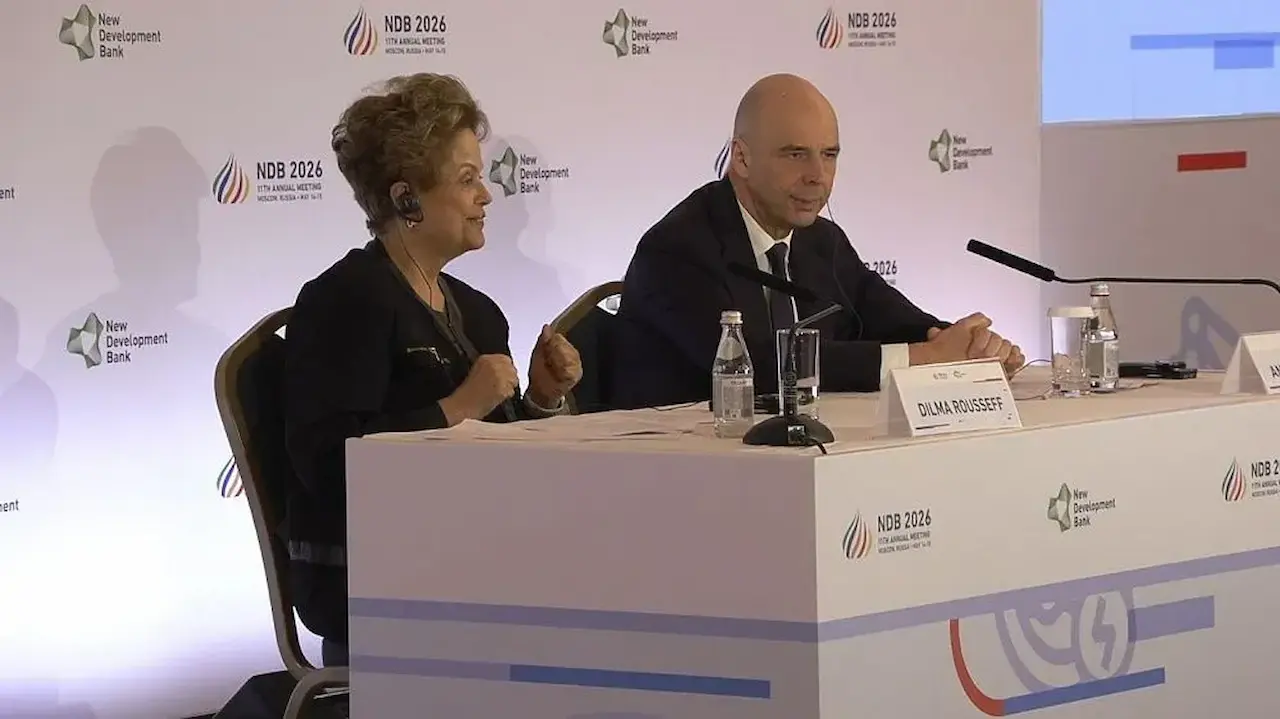


The New Development Bank (NDB), widely known as the BRICS Bank, has entered the final preparation stages for issuing debt securities denominated in Indian rupees. The announcement was delivered by the institution’s president, Dilma Rousseff, during the NDB Board of Governors annual meeting held in Moscow between May 14 and 15.
The move deepens the institution’s financial consolidation blueprint across the Global South, replication a model recently deployed with the South African rand. According to Rousseff, raising capital through local currencies stands as the core pillar to guarantee the political and operational autonomy of the entity, decreasing historical reliance on assets pegged to the U.S. dollar.
Long-term strategy prioritizes Chinese yuan and new currencies
This shift in the fundraising profile is not an emergency measure, but a structural macroeconomic policy. Currently, the Chinese yuan holds a commanding lead in the volume of funding and investments executed by the bank outside conventional Western currency circuits.
Russian Finance Minister and current Chairman of the NDB Board of Governors, Anton Siluanov, confirmed that China maintains significant weight in directing capital flows. According to the minister, the bank already executes nearly 30% of its financing using the native currencies of member countries, mapping out ambitious goals for the coming decade.
Bloc expansion and tokenization on the 2031 horizon
The reshaping of the NDB is also reflected in the expansion of its corporate roster. Siluanov formalized the entry of four new shareholders into the institution’s corporate structure: the United Arab Emirates, Bangladesh, Egypt, and Algeria. Concurrently, the bank’s technical staff is evaluating admission reports for the inclusion of Colombia, Ethiopia, and Uzbekistan.
For the next planning cycle, Dilma Rousseff detailed the foundations of a new five-year strategy, which highlights the following goals:
- Strengthening the domestic capital markets of emerging economies.
- Broadening the financing base with an exclusive focus on the Global South.
- Advanced research for implementing financial asset tokenization processes.
NDB financial transition targets
The evolution of utilizing domestic currencies showcases the velocity of governance transition at the BRICS bank:
| Operational Indicator | Current Scenario (2026) | Strategic Target (By 2031) | Implementation Status |
| Local Currency Financing | Approximately 30% | Exceeding 45% | Under gradual expansion |
| Primary Active Currencies | Yuan (leader) and Rand | Inclusion of Indian Rupee | Bonds in final stages |
| New Effective Members | 4 integrated countries | 3 nations under review | Geopolitical alignment |
Consolidating national currencies in infrastructure operations aims to shield developing nations against interest rate shocks promoted by the Federal Reserve. With this new round of capital raises in Asia, the NDB establishes itself as the main counterweight to traditional financial mechanisms like the International Monetary Fund (IMF) and the World Bank.