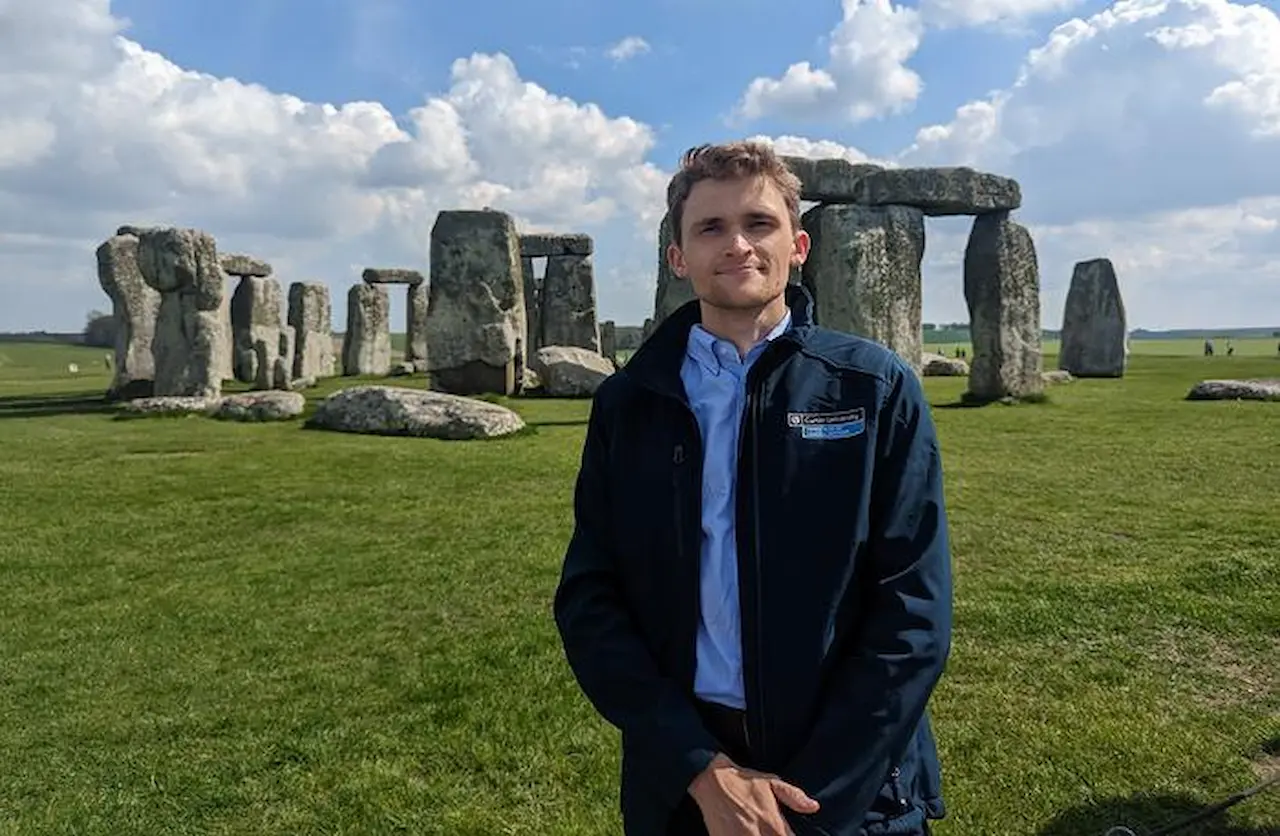

The engineering of Neolithic societies has just gained a new scientific and documentary outline. Research led by Curtin University revealed that the central Altar Stone of Stonehenge was transported deliberately. The sandstone megalith, weighing about six tons, traveled from northeast Scotland to the famous Salisbury Plain. The journey of approximately 700 kilometers required logistical mastery that challenges ancient perceptions of human capability.
The study published in the Journal of Quaternary Science definitively dismisses geographical determinism in the monument’s construction.
Glacial forces and collective human effort
Historically, the movement of monolithic structures of this magnitude generated intense debates about the role of natural forces. Previous hypotheses maintained that Ice Age glaciers had dragged the stones to southern Britain. The new computational modeling combined with mineral grain dating proved the exact opposite. Researcher Anthony Clarke demonstrated that no viable glacial paths existed to the final destination.
The advance of ice sheets may have partially moved rocks to the North Sea, but the remaining journey depended on human traction.
Materiality of ancient structural logistics
To enable the colossal project, Neolithic communities needed to articulate a highly coordinated transport system. The effort was not limited to simply dragging a massive stone over the earth in a rudimentary way. The research points to a complex combination of logistical modes adapted to the irregular topography of ancient Britain. The route mapping suggests advanced tactics for the time:
- Use of strategically planned overland routes to avoid steep inclines and save human energy.
- Utilization of an interconnected river network to enable the flotation of the heavy sandstone on rafts.
- Possible coastal navigation bypassing geographical margins when overland transport proved unfeasible.
The multi-stage transport reflects social cohesion and clarity of purpose unparalleled for the period.
Planning and sociopolitical cohesion of communities
The level of organization required to move a six-ton block over 700 kilometers exposes the structural complexity of these ancient communities. Transporting the Altar Stone required ultra-long-term planning, deep territorial geographical knowledge, and severe cooperation. This is not a demonstration of brute force, but a masterful management of resources and collective labor.
The next phases of the British and Australian research will seek to identify the exact extraction point of the stone in the Scottish highlands.
The exploration of these ancient transport routes reinforces how data science and geology rewrite civilizational history. The ability to articulate a colossal logistical effort demonstrates that structural advancement predates modern engineering tools by millennia.