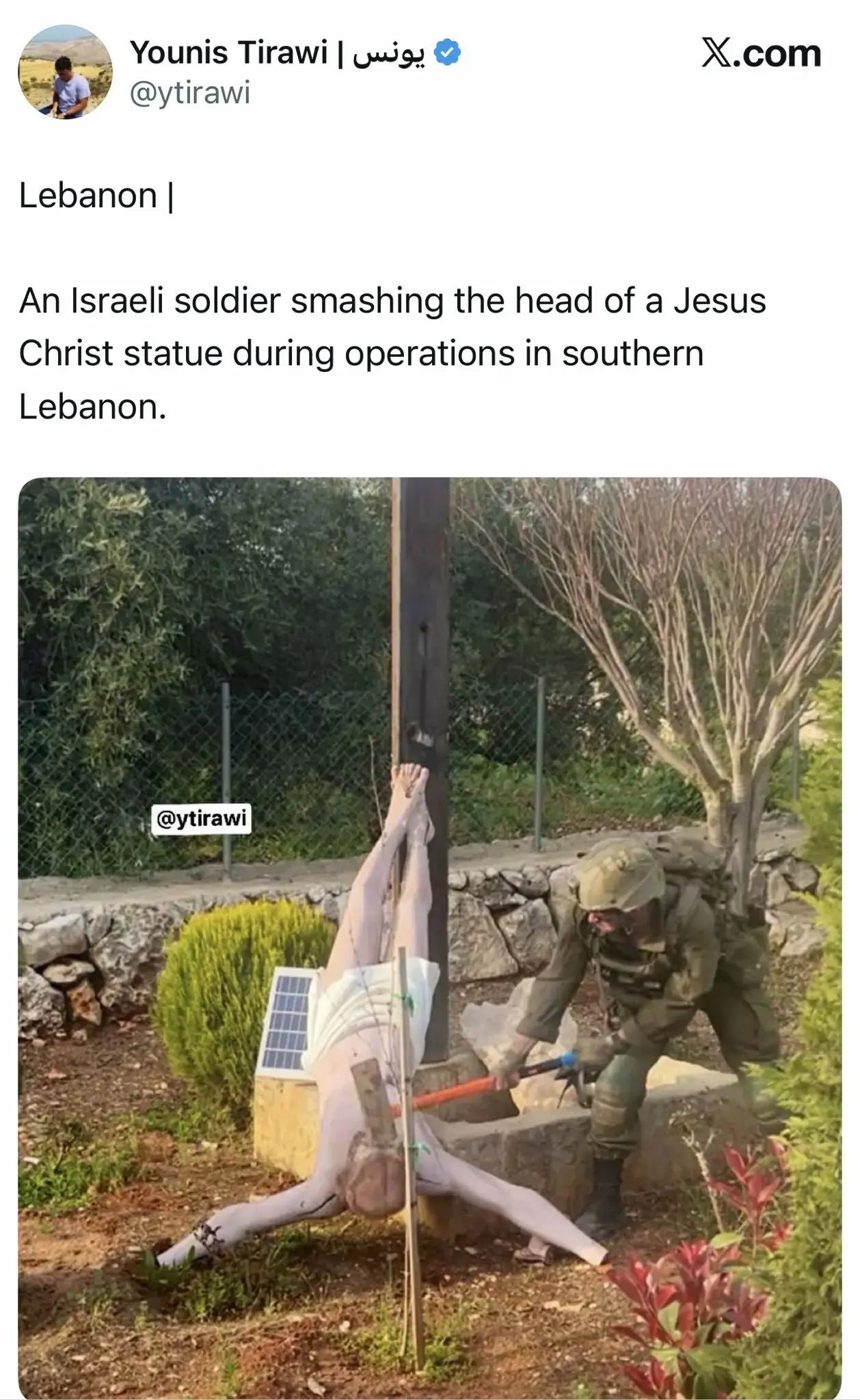

The fragile stability in southern Lebanon was shaken by an image that transcends military conflict and strikes at the heart of global religious sensitivity. An Israeli Defense Forces (IDF) soldier has been identified as responsible for destroying a statue of Jesus Christ in the Christian village of Debel. The record, filmed by the soldier himself and shared on social media, shows the use of a sledgehammer against the sacred symbol.
The episode occurs at a moment of extreme tension, shortly after the start of a ceasefire between Israel and Hezbollah. The village of Debel, primarily inhabited by Maronite Christians, became the setting for an act that the Israeli military authorities themselves classified as “completely incompatible” with the troops’ values. The fallout was immediate, sparking condemnation from religious and diplomatic leaders.
The anatomy of a diplomatic incident
The Israeli Army moved quickly to confirm the image’s authenticity after the content went viral. Spokesperson Nadav Shoshani stated that Northern Command has already launched a detailed investigation into the soldier’s conduct. According to the official statement, the case is being handled with “great severity” by Tel Aviv’s military leadership.
However, for international analysts, the vandalism in Debel is not an isolated event, but the culmination of a series of undisciplined behaviors. The sharing of such images by soldiers in combat zones has been a recurring issue for Israel’s public image. The act of destroying a Christian symbol in Lebanon adds a layer of sectarian complexity to a war already marked by brutality.
A history of tensions with Christian communities
The destruction of the statue in Debel follows a recent history of friction between Israeli security forces and the Christian clergy. In March 2026, Catholic leaders reported being prevented by Israeli police from performing prayers at the Holy Sepulchre during Palm Sunday. These restrictions have fueled a sense of vulnerability among religious minorities in the region.
Furthermore, intelligence reports and NGO complaints point to an increase in property seizures and the destruction of civilian assets without operational justification. In early 2024, Benjamin Netanyahu’s army’s own legal counsel issued formal warnings to field commanders. The document cautioned against war crimes related to the misuse of force and the appropriation of property in Gaza and Lebanon.
Chronology of Incidents and Military Conduct (2024-2026)
| Period | Location | Reported Incident | Official Status |
| Oct 2023 – 2024 | Gaza Strip | Looting and destruction of civilian property | Internal legal warning |
| March 2026 | Jerusalem | Clergy blocked at the Holy Sepulchre | Security justification |
| April 2026 | Debel (Lebanon) | Destruction of Jesus statue with sledgehammer | Active investigation |
The impact on regional alliances
The incident in Debel is particularly sensitive because it involves the Lebanese Christian community, which historically attempts to maintain a position of neutrality or mediation in the conflict between Israel and Hezbollah. Religious vandalism could push these communities toward a firmer alignment against Israeli operations on Lebanese soil. The Maronite Church, which holds significant political influence, has yet to issue a wide-ranging formal statement, but the atmosphere is one of consternation.
Diplomatic sources in Beirut suggest that the Lebanese government intends to take the case to international forums as evidence of violations of occupation laws. Although the ceasefire is in effect, acts of this nature serve as fuel for the resumption of hostilities. The protection of religious sites is a mandatory norm of International Humanitarian Law, and its violation carries high political costs.
Vandalism Patterns and the IDF Response
- Social Media Monitoring: The IDF has intensified surveillance over soldiers’ posts, but controlling individual narratives has proven ineffective.
- Exemplary Punishments: Northern Command is considering severe punishment to deter further acts of digital “war trophies.”
- Inter-religious Dialogue: Parallel diplomacies are attempting to mitigate reputational damage with the Vatican and Eastern patriarchates.
The future projection of military discipline
The future of the partial occupation in southern Lebanon depends not only on the silence of the guns but on the conduct of the men on the ground. If the investigations into the soldier in Debel conclude without transparent punishment, the narrative of impunity will gain strength. For Israel, maintaining the discipline of its troops is a matter of strategic survival in the face of Western public opinion.
The case now moves to the Ministry of Defense, where it will be decided if the soldier will face a court-martial. Meanwhile, in the village of Debel, the empty pedestal of the Jesus statue remains as a physical reminder of the scars that war leaves beyond political borders. The hammer that shattered the plaster may have also struck diplomatic bridges that took decades to build.