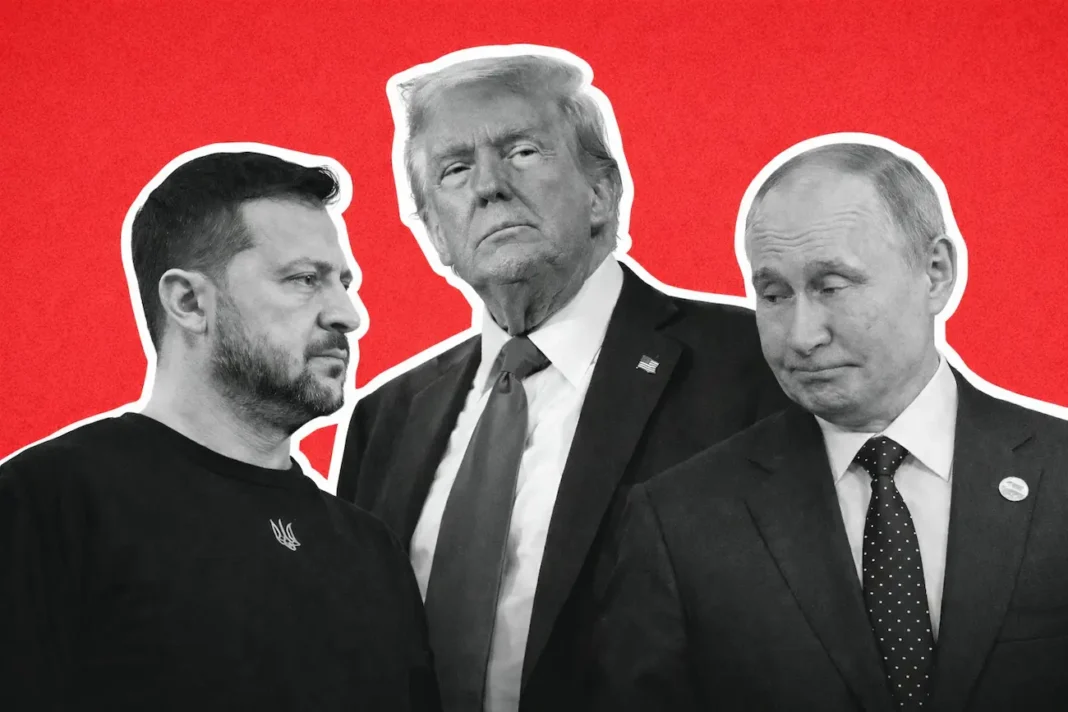

The global geopolitical landscape of 2026 has reached its most critical juncture this Thursday, February 5, as a new and aggressive round of peace negotiations begins in Washington. This phase, heavily brokered by the Donald Trump administration, operates under a brutal irony: while negotiators Rustem Umerov and Kirill Dmitriev discuss “synchronizing positions,” the Ukrainian territory is reeling from a massive strike involving over 520 missiles and drones. This is not merely a ceasefire discussion; it is the forced reconfiguration of European security architecture after nearly four years of grueling attrition. Washington’s pressure is pragmatic and relentless, aiming for a resolution that stops the massive drain on US resources in an era of global economic restructuring.
Washington’s Diplomatic Pincers
American strategy in 2026 has solidified into a form of “aggressive mediation.” Following preliminary talks in Abu Dhabi and Florida, the US government is acting as the ultimate arbiter, pushing Kyiv to accept territorial concessions in exchange for security guarantees that bypass NATO. For the Trump administration, the “real and dignified end” mentioned by Zelensky must be weighed against the reality of a stagnant front and a Western Europe increasingly hesitant to maintain indefinite funding for Ukrainian resistance. The “progress” reported by Dmitriev suggests Moscow sees a window to consolidate land gains before a permanent shift in international power dynamics.
Editorial Perspectives
Winter as a Negotiating Lever
Russia is utilizing the 2026 climate as a literal extension of the negotiating table. The recent strike against Kyiv’s infrastructure, which left over 1,100 residential buildings without heat during the decade’s harshest winter, is a clear signal: Russian diplomacy moves in tandem with its ability to degrade Ukrainian civilian life. By crippling the energy system during sub-zero temperatures, the Kremlin seeks to exhaust Zelensky’s political will, forcing him to negotiate from a position of absolute vulnerability. This “energy terrorism” serves as the dark shadow to the technical talks being conducted by working groups in D.C.
Donbas and NATO: The Inflection Points
The territorial impasse remains the primary obstacle to a 2026 deal. Moscow demands not only total control of the Donbas but also the cession of Donetsk areas still held by Ukraine and the total demilitarization of its neighbor. Conversely, the 12-point peace plan backed by the EU seeks to preserve sovereignty over unoccupied areas while ensuring an accelerated path to European Union membership. The definitive rejection of NATO, a non-negotiable Kremlin demand, is the Gordian knot that American mediators are trying to cut with proposals for bilateral security pacts that circumvent the Atlantic alliance.
Reconstruction and the Unfreezing of Assets
A pillar of the 2026 negotiations involves the financial logistics of the post-war era. The European-backed plan suggests using frozen Russian assets to fund Ukraine’s reconstruction, while Moscow demands a phased lifting of sanctions and the return of its assets as a prerequisite for any military withdrawal. The proposed Peace Council, supervised by Washington, is intended to monitor ceasefire compliance. However, deep-seated mutual distrust, fueled by continuous strikes during the talks, makes the implementation of such mechanisms an unprecedented technical and political challenge.
The Human Cost of Pragmatism
For the people of Kyiv, the 2026 negotiations are a race against freezing and darkness. Foreign Minister Andrii Sybiha’s report on “winter terror” highlights the urgency of an outcome that moves beyond paper. The Ukrainian government faces a harrowing dilemma: cede territory for peace or maintain national integrity at the cost of an imminent humanitarian catastrophe. While Trump signals “good news,” the reality on the ground is a state of armed peace, where every word spoken in Washington is punctuated by explosions on Ukrainian soil. The outcome of this round will determine if 2026 is the year of reconstruction or the consolidation of a new Iron Curtain.
Takeaways
- Washington pushes for a pragmatic end to the conflict to curb long-term financial commitments.
- A Russian offensive involving 520 vectors has crippled heating for 1,170 buildings in Kyiv.
- NATO membership remains the ultimate deal-breaker in 2026 negotiations.
- The EU 12-point plan proposes using frozen Russian assets for Ukrainian reconstruction.
- Mediation has moved from neutral ground in Abu Dhabi to direct US-led talks in D.C.
Key Facts
- Negotiation Date: February 5, 2026.
- Offensive scale: 450 drones and 70 missiles used in a single 24-hour window.
- Conflict Duration: Approaching the 4-year mark.
- Negotiators: Rustem Umerov (Ukraine) and Kirill Dmitriev (Russia).
- US Role: Direct mediation led by the Trump administration.
- Humanitarian Impact: Record-low temperatures complicating civilian survival in Kyiv.
- Economic Terms: Gradual lifting of Russian sanctions linked to military withdrawal.