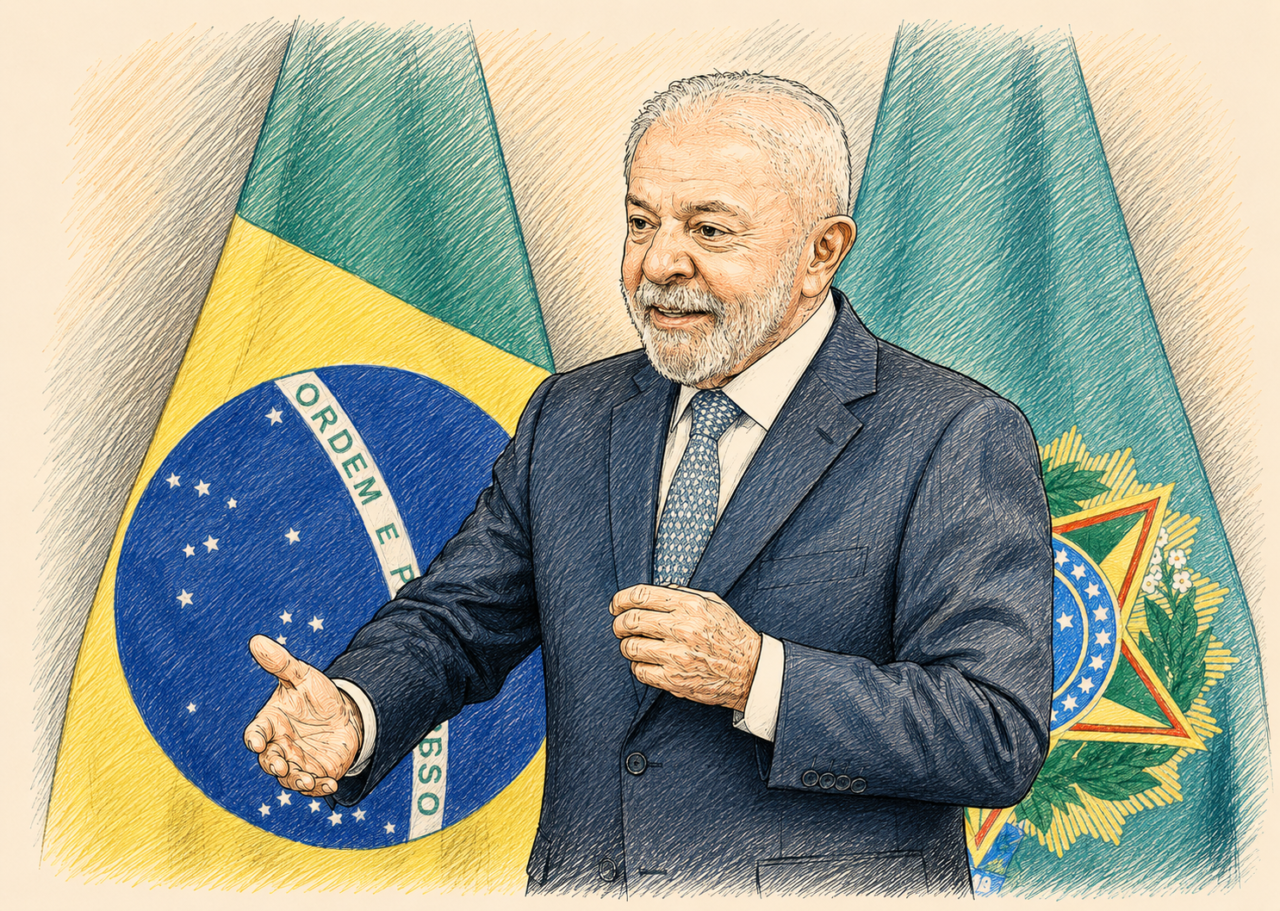
President Luiz Inácio Lula da Silva utilized his platform in Madrid this Saturday to deliver a rhetorical blow against the inertia of major powers regarding the proliferation of armed conflicts.
With a tone blending diplomatic urgency and contempt for institutional paralysis, the Brazilian leader demanded that heads of state from nuclear and hegemonic nations abandon the “madness of war.
” The speech, delivered during an official agenda in Spain, directly targets the power centers that currently dictate the pace of global geopolitics through gunpowder.
Lula did not hold back on the recipients of his message. He explicitly named Donald Trump, Xi Jinping, Vladimir Putin, Emmanuel Macron, and Keir Starmer, calling them to an extraordinary meeting to end the hostilities currently suffocating the global economy and stability.
By personifying the demand, the Brazilian president shifts the debate from the abstract field of diplomatic notes into the lap of the individual responsibility of leaders. For the Planalto, the arms escalation is not a natural phenomenon, but a deliberate political choice that must be reversed through argument.
The secondary—but no less significant—target of the presidential artillery was the UN Security Council. Lula obliterated the current relevance of the body, stating that the institution has drifted far from its original function of maintaining peace.
In the president’s view, the Council today serves more as a theater for vetoes and parochial interests than as an effective mediator. This institutional critique reinforces the Brazilian thesis that the global governance system inherited from the post-war era is exhausted and requires a reform that reflects 21st-century multipolarity.
The cost of the Global South
Lula’s narrative establishes a direct connection between military spending and the deepening of inequalities. The argument is surgical: while billions of dollars are incinerated on battlefronts, the Global South foots the bill through food inflation, energy crises, and the dehydration of social investments.
The speech in Spain positions Brazil as the spokesperson for a bloc of nations that refuses automatic alignment with military blocs and demands that human development regains center stage at the negotiation tables.
This posture of active neutrality, however, walks a fine line. By simultaneously challenging leaders with interests as antagonistic as Trump and Putin, Lula attempts to reaffirm Brazilian sovereignty as a universal mediator.
The institutional sarcasm of the Itamaraty (Brazil’s Foreign Ministry), reflected between the lines of the presidential speech, suggests that the powers are more concerned with maintaining their spheres of influence than with the survival of the global social fabric.
Perspective and the 2026 scenario
In the current 2026 context, with a fragmented international chessboard and new tensions emerging at record speed, Lula’s call for a summit sounds like an open challenge to the establishment.
Diplomatic intelligence observes that Brazil is attempting to capitalize on its role in the G20 and the BRICS to force a de-escalation agenda that Western and Eastern powers seem largely unwilling to embrace.
The effectiveness of this “peace through argument” strategy will be tested in the coming months. Until then, the speech in Spain serves as a dossier of the frustrations of the Global South.
Lula knows that peace is not merely the absence of gunfire, but the presence of resources that are currently being obliterated by the war industry. The message has been sent: the patience of the world’s periphery with the “madness” of imperial centers has reached its technical limit.