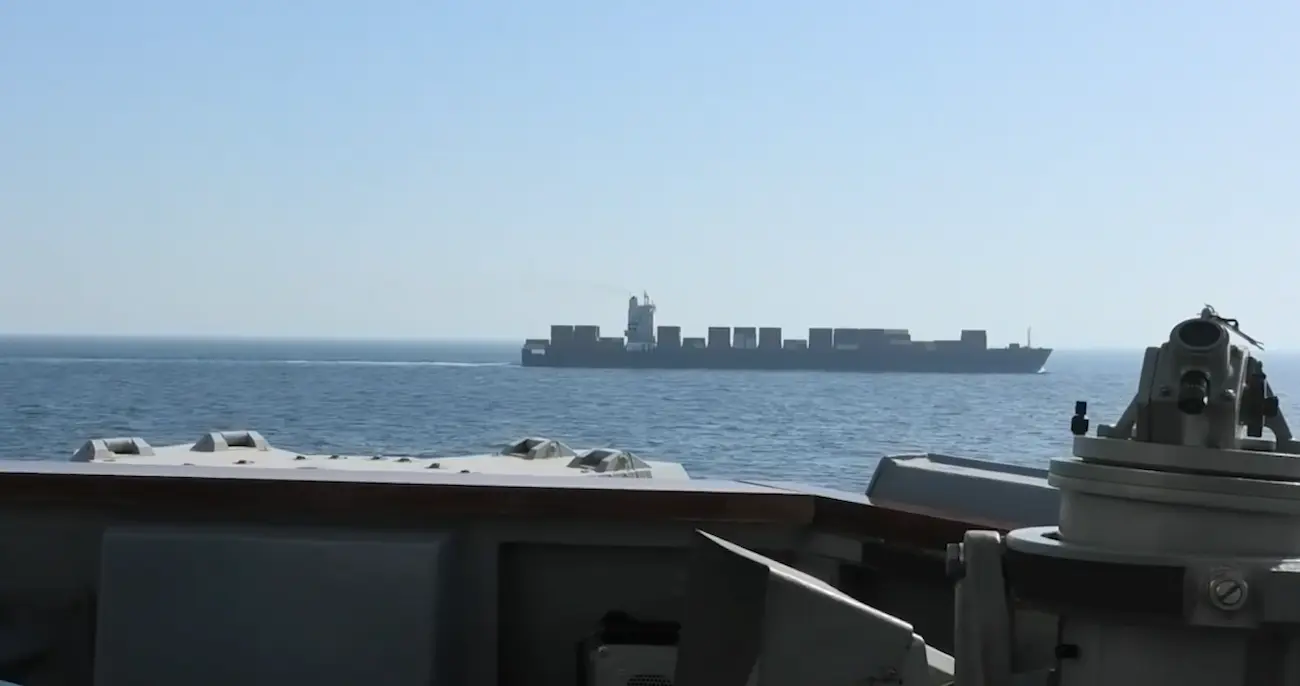

The geopolitical landscape in the Middle East reached a new boiling point this Sunday, April 19, 2026. President Donald Trump confirmed that the United States Navy forcibly seized the Iranian-flagged freighter Touska.
The interception took place in the Gulf of Oman after the vessel ignored orders to stop. According to the official statement, a guided-missile destroyer was responsible for immobilizing the ship by striking its engine room directly.
This marks the first direct seizure action since Washington established a total blockade of Iranian ports last week. U.S. Marine Corps troops have already assumed control of the deck and are conducting detailed cargo inspections.
Dangerous dynamics in the Strait of Hormuz
The American military action follows a series of incidents that have paralyzed commercial traffic in the region. The Strait of Hormuz, through which one-fifth of the world’s oil transits, has become a de facto exclusion zone.
Iran reacted to the blockade by reimposing strict restrictions and conducting attacks against European-flagged vessels. The French naval group CMA CGM confirmed that one of its container ships was targeted by warning shots in the region.
Tehran’s rhetoric classifies the American blockade as a “war crime” and “collective punishment.” Meanwhile, Washington justifies the measures as necessary to contain the war effort and the rearmament of the Revolutionary Guard.
Diplomacy under fire
The incident with the ship Touska casts a shadow over the round of negotiations scheduled for Monday in Islamabad. Although Trump announced the deployment of JD Vance and Jared Kushner to Pakistan, Tehran has not yet confirmed its attendance.
The Pakistani mediator maintains intense efforts, but distrust between the parties has never been higher. The current ceasefire expires next Wednesday, and the seizure of the freighter could be the trigger for a full resumption of hostilities.
- Main tension targets:
- Total naval blockade of Iranian ports.
- Free transit through the Strait of Hormuz (currently paralyzed).
- Iranian civilian infrastructure (bridges and plants under Trump’s threat).
- Missile and drone arsenal of the Revolutionary Guard.
Economic and Energy Impact
The crisis is already reflected in global energy indicators, with Brent crude prices showing extreme volatility. Washington’s decision to extend exemptions for Russian oil was seen as a pragmatic move to avoid a logistical collapse in Asia.
Experts warn that keeping the strait closed for more than 72 hours could cause an unprecedented inflationary shock this decade. The market desperately awaits a signal of a “happy ending,” as predicted by Energy Secretary Chris Wright.
Conflict Status in April 2026
| Indicator | Current Status | Key Location |
| Naval Blockade | Active and Rigorous | Iran Coast / Gulf of Oman |
| Commercial Transit | Restricted/Paralyzed | Strait of Hormuz |
| Ceasefire | Fragile (Expires Wednesday) | Iran/Lebanon/Israel Borders |
| Military Presence | US 5th Fleet / Revolutionary Guard | Persian Gulf |
The ‘Yellow Line’ in Israel
Simultaneously, on Lebanese soil, Israel has consolidated a new advanced defense line. The measure aims to prevent the return of Hezbollah militias to strategic villages near the northern border.
The presence of five Israeli divisions in southern Lebanon is sparking protests in Beirut, while residents of northern Israel demand the total elimination of the threat before returning to their homes. The 2026 board remains fragmented and highly unstable.